• Biology

    Biology

    The atom, biological macromolecules (carbohydrates, lípids, proteins, nucleic acids), cell biology, cancer

  • Drugs

    Drugs

    Drug development, pharmacodynamics, pharmacokinetics, toxicology

  • Nanomedicine

    Nanomedicine

    Introduction to nanotechnology, diagnostic devices, drug delivery, regenerative medicine

  • Miscellaneous

    Miscellaneous

    A more in-depth explanation of topics previously mentioned in the other sections

1.3.3. A case study: developing inhaled products

0 comments
Delivering aerosols via inhalation has been practiced for millennia. As a matter of fact, since prehistory, where men began to use certain subtances with therapeutical and hallucinogenic purposes, such as cohoba (made from the beans of a mimosa species) or cannabis.

But aerosols only first replaced oral medication (tablets, pills, capsules…) in the 1950s for the treatment of respiratory diseases because oral medication caused severe side effects. The first meter-dose inhaler was made simply from a Coke bottle, some perfume valves and propellant systems.
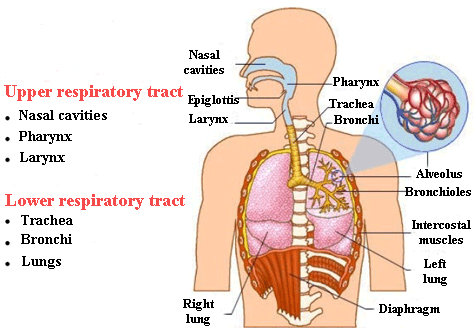
Respiratory system
The main challenge that aerosols face to penetrate the lungs and the upper airways (mouth, pharynx, larynx and trachea) is that these organs are very well equipped to filter dust and other particles. Hence, the challenge consists of designing the aerosol particles in such a way that they do not end up in the mouth or throat as opposed to the lungs.
These particles must be produced with a size or aerodynamic diameter between 1 to 5 μm, in order to pass beyond the upper airways, which act as a filter. As you can imagine, manufacturing such tiny particles is a hugely complex task.
For instance, those microscopic particles which are made of dry powder, have a very large surface area, which makes them very sticky. Consequently, the major force that acts on them is Van der Waals interaction (“Chemical bonds”) and not gravity (e.g. when you write with a chalk on a chalkboard it stays on and does not fall off due to these interactions rather than gravity). So, the objective is to overcome these Van der Waals forces and develop methods of deaggregating aerosol particles.

Lots of the aerosols used to treat pulmonary pathologies (e.g. cystic fibrosis, Chronic Obstructive Pulmonary Disease or COPD and asthma) are not really well designed for patient use.
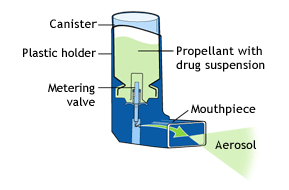
Metered-dose inhaler
For example, metre-dose inhalers have been used successfully for many years, however a lot of patients, especially children and the elderly, cannot or do not use them correctly. These inhalers present a major difficulty for those with coordination issues in activating the actuation manoeuvre with the inhalation manoeuvre.

On the other hand, the dry powder inhalers that we find currently on the market are allMultidose dry powder inhalers all active, which means that the patient needs to provide all the necessary energy so that the aerosol gets into the lungs via the airways.
The efficacy of these type of aerosols depends on how hard you inhale through the device. In this way, if you do not breath fast or strong enough, the aerosol particles will not be deaggregated enough to reach the lungs and they will mainly accumulate in the throat.
As a consequence, these sort of inhalers are not suitable for those patients who do not have proper lung function.
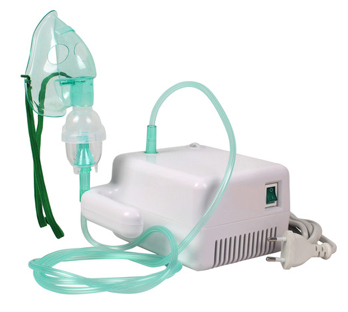
Portable nebulizer
A third type of inhaler is a nebulizer or water-based nebulizer spray systems, usually bulky units, not very portable, used at home or in the clinic, although some technical developments have been made lately to make them more portable and battery operated.

So, these are the different devices for the treatment of respiratory diseases by the inhalation route and their selection is based upon the patient’s needs and the kind of drug to be delivered.

There is an interesting story about the formulation of the meter-dose inhalers. At the beginning, when these devices were invented, back in the 1950s, they used chlorofluorocarbon (CFCs) propellants into which the drug was suspended or dissolved. But, due to reports in the 1970s about ozone layer depletion because of the use of these propellant gases, and their subsequent ban in the late eighties, the pharmaceutical industry replaced them with hydrofluroalkanes (HFAs) with similar chemical and physical properties to the CFCs.

In spite of comparable properties, the HFAs behaved in a very different way with the pharmacological molecules and the rest of excipients. For example, some surfactants[1] used in drug formulation, like oleic acid, were soluble in the CFCs but not in the HFAs.

Because of this pharmaceutical companies adopted several strategies to reformulate the same drug into these propellants gases.
A meaningful example is the product called QVAR[2], in which the drug is dissolved, using a co-solvent (diluent), specifically ethanol, together with hydrofluroalkane propellants. And it turned out that the aerosol produced is a much finer mist with a much finer droplet size. In this way, the amount of aerosol particles deposited in mouth and throat decreased tremendously, but, on the other hand, there was a dramatic increase in lung delivery.
This new approach provided a competitive advantage for the company that created it in comparison to the competition, which tried to adapt the performance of the HFA propellants in a similar way to the older-style CFCs.


[1] Substance that act as a detergent, emulsifier or humectant and allows to reduce the surface tension in a fluid. 
[2] Anti-inflammatory inhaler indicated for the treatment of asthma attacks.

Sources: UTAustinX: UT.4.01x Take Your Medicine - The Impact of Drug Development.
              http://www.telegraph.co.uk/news/newstopics/howaboutthat/3225729/Stone-Age-man-took-drugs-say-scientists.html
              http://es.slideshare.net/CAWIMECA/el-sistema-respiratorio-42882484 
              http://blogs.20minutos.es/yaestaellistoquetodolosabe/tag/clorofluorocarbonos/
              http://definicion.de/surfactante/
              http://www.asthma.ca/adults/treatment/meteredDoseInhaler.php
              http://es.slideshare.net/luciagorreto/taller-asma-2015-inhaladores
              http://www.drtrust.in/products/nebuliser-machine


Read more
3.3. Lipids

0 comments
Lipids are a type of hydrocarbon mostly made up of nonpolar C-C and C-H bonds, which makes them hydrophobic (they repel water) or insoluble in water.
Lipids (more commonly known as fats) constitute a basic element in many hormones, as well as in cell membranes. They are an important source of long-term fuel for cells, they provide heat insulation for both animals and plants and they form a protective hydrophobic outer layer over fur or feathers of aquatic birds and mammals.
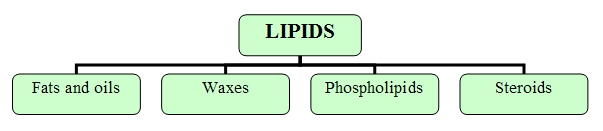
Within lipids we find the following categories:


Fats and oils

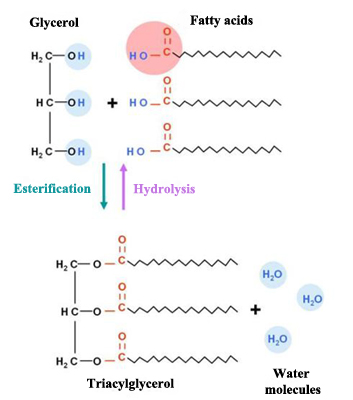
Fats, due to their chemical structure, are also named triacylglycerols or triglycerides. They are made up of two basic components: glycerol and fatty acids.
Glycerol is an organic component (specifically, a kind of alcohol) with three carbon atoms, five hydrogen atoms and three hydroxyl groups (OH). Fatty acids, in turn, are composed of a long chain of hydrocarbons to which a carboxyl group is attached.
The number of carbon atoms in fatty acids generally vary between four and thirty-six, although the most common contain 12 to 18 carbons. Fatty acids’ three carbon atoms (in the glycerol molecule) are joined by an ester bond and an oxygen atom. During the formation of this bond three water molecules are released.
Triglyceride formation
Fatty acids are divided into two groups: saturated and unsaturated.
The first only have simple bonds between the adjacent carbons of the hydrocarbon chain. An example is the stearic acid formed by 18 carbon atoms and in which the number of hydrogen atoms attached to the carbon backbone is the maximum (no more hydrogen atoms can be attached). This acid is present in oils and in animal and plant fats. Among its uses we find the manufacturing of soaps, candles, plastics, cosmetics and as a softening agent for rubber.

Unsaturated fatty acids, on the contrary, have double bonds between their carbon atoms. Among the most common unsaturated fatty acids we find oleic acid, known for its beneficial impact on blood vessels, thus decreasing the risk of liver and cardiovascular diseases.

Unsaturated fatty acids are popularly known as oils, which are liquid at room temperature and can be monounsaturated when they have one double carbon bond in the molecule (olive oil) or polyunsaturated if they have more than one (canola oil).
Adipose cells (adipocytes)

Plants store fats or oils in their seeds, which are used as energy deposits during their development. In mammals, however, fat constitute globules, which take up most of the volume of a very specialised kind of cell called an ‘adipocyte’.

Unsaturated fats or oils have usually a plant origin and contain cis unsaturated fatty acids (visit the entry “The carbon atom” to remember the concepts cis and trans configuration). This cis double bond causes a bend or “twist” which prevent fatty acids from being compacted, keeping them in liquid state at room temperature. As examples of unsaturated fats: olive, corn, canola and cod oils. These kinds of fats help us to reduce our cholesterol levels (in contrast to saturated fats which contribute to the formation of plaques in our arteries).

Trans fats
Trans fats are present in some food products like margarine or peanut butter and can lead to increased levels of low density lipoproteins (LDL), more commonly known as “bad” cholesterol, which is deposited on arteries walls as plaque, producing cardiovascular disorders.
These trans fats are manufactured by the food industry by a method called ‘hydrogenation’, in which the double bonds of the cis structure of the hydrocarbon chain become double bonds in the trans configuration. During this process, oils are solidified by injecting gaseous hydrogen into them, so that they can acquire that desirable semisolid consistency in many processed foods.

Omega fatty acids
Both omega-3 fatty acids and omega-6 fatty acids belong to the group of the essential fatty acids that our organism requires but is not able to synthesise; thus we must ingest them through our diet.
The terms omega-3 and omega-6 indicate that the third and the sixth carbon, counting from the far end of the hydrocarbon chain, are the ones that are attached to their adjacent carbon by a double bond.
Omega-3 fatty acidOmega-6 fatty acid


Among the food sources of omega-3 we find some oily fish like trout, tuna and salmon. These types of fatty acids reduce blood pressure and the triglyceride levels in blood, they help to prevent thrombosis, heart attacks and may help to decrease the risk of certain kinds of cancer.

Fats are not only excellent energy deposits in the long term and provide isolation for the body, but also enable us to digest fat-soluble vitamins. Therefore, despite the bad publicity that they have received, the “healthy” fats must be consumed in balanced diets regularly.


Waxes

Waxes are comprised long chains of fatty acids esterified[1] to long-chain alcohol.
Because of their hydrophobic nature, they perform a protective function on the outer coating of the leaves of some plants and the feathers of aquatic birds.
Esterification reaction


Phospholipids

Phospholipids are formed by fatty acid chains attached to a glycerol or sphingosine[2] backbone, where two fatty acids make up a diacylglycerol molecule and the third carbon of the glycerol backbone is occupied by a modified phosphate group.
The compound formed by the diacylglycerol molecule and the phosphate group constitute the phosphatidates, which are the precursors of phospholipids.
Phospholipids are part of the outer layer of animal cells and the main element of plasma membranes, which play a fundamental role in the cellular communication.
Phospholipid structure
Phospholipids make up these membranes in such a way that the phospholipid tails (which are hydrophobic fatty acids that cannot interact with water) face internally and the phospholipid head (which is the hydrophilic phosphate group that interacts with water) faces externally, in contact with the aqueous environment. By having a hydrophobic and a hydrophilic part, phospholipids are classified as amphiphatic molecules.
Phospholipid bilayers of cell membranesMicelle structure
The dynamic nature of plasma membranes is due to their being formed by phospholipids. In contact with water, phospholipid molecules are ordered spontaneously in a spherical structure called a micelle, with the heads (polar) facing the outside and the tails (nonpolar) facing the inside of these structures, just like plasma membranes.


Steroides

In spite of the fact that steroids are not very similar to the rest of the lipids, on account of the fact that they have a fused ring structure, they are included within this category as they are insoluble in water.
All steroids are made up of four carbon rings and many of them also have the –OH functional group, which allows them to be classified as alcohols (sterols).
In addition, some of them, like the cholesterol molecule, have a short hydrocarbon tail. Cholesterol is the most common steroid in the human being and animals, it is synthesised in the liver and is the precursor to vitamin D and also of bile salts, which help to metabolise the fats we ingest to be absorbed by cells afterwards.
Cholesterol is secreted by the endocrine glands and the gonads, as it is the precursor of steroid hormones like estradiol[3] and testosterone. Therefore, despite the bad name that cholesterol has among lay people, this molecule plays a vital role for the proper functioning of our organism.
Schematic classification of lipids


[1] Esterification reactions are those by an ester is obtained, usually from the reaction of a carboxylic acid and an alcohol.
Esters are organic compounds made by substituting an acid by an alkyl or other organic group.
[2] Amino alcohol made up of 18 carbons, forming an unsaturated hydrocarbon chain.
[3] Female sex hormone.

Sources: OpenStax College, Biology. OpenStax College. 30 May 2013.
              http://www.genomasur.com/BCH/BCH_libro/capitulo_02.htm
              http://www.salud180.com/sustancias/acido-estearico
              http://herbolaria.wikia.com/wiki/%C3%81cido_oleico
              https://www.flickr.com/photos/thame/3302072732
              http://www.eufic.org/article/es/artid/La-importancia-de-los-acidos-grasos-omega-3-y-omega-6/
              http://www.uhu.es/08007/documentos%20de%20texto/apuntes/2005/pdf/tema_03_lipidos.pdf
              http://www.fisicanet.com.ar/biologia/introduccion_biologia/ap11_lipidos.php
              http://brainly.com.br/tarefa/453268
              http://www.calpoly.edu/~jfernsle/Research/Biophysics/BiophysResearch.html


Read more

1.3.2. Routes of drug administration

0 comments
After gathering all possible information about the lead compound, researchers must now understand how to manufacture a drug product. This applies not only to the lead compound but also to other chemicals that favour its disolution in the gastrointestinal (GI) tract, help in the manufacturing process or protect it from degradation.

In addition to all these subtances, a wide array of products are added. In tablets, for example, cellulose is often included to improve the drug disintegration in the digestive fluids. Talc is also included in low concentrations during the manufacturing to absorb liquid and semi-liquid subtances. Lactose, or milk sugar, is often aggregated to bulk the tablet, acquiring a convenient size so that the patient can hold and swallow it.
Some tablets contain functional polymers to develop certain drug attributes. One of the main uses of functional polymers is to protect the tablet from the high acidity in the stomach, thus ensuring that the drug is dissolved in the small intestine later, and in this way improving its absortion in the intestinal fluids.

Even though a drug can be administered in many different ways, I will focus on those drugs that are administered orally to focus on the following questions:
Will the drug be dissolved and absorbed?, depending on how much it is absorbed, what should the dose be?, is it metabolised by the liver quickly after its absortion?, will it be degraded by the acidic media in the stomach?
With regard to the last question many drugs can be degraded at low pH.
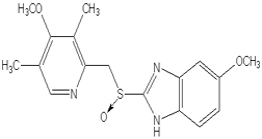
Chemical structure of Omeprazole
An example of these kinds of drugs is omeprazole, which without a functional polymer would not be effective. The purpose of this polymer is to preserve the omeprazole granules from direct contact with the gastrointestinal fluid until the pH becomes less acid and the drug is no longer in danger of being degraded. For this reason, it is important to remember that tablets and pills must not be broken, unless the pharmacist indicates it, or the polymer coating would be damaged and the drug would not be effective.
Routes of drug administration
Undoubtedly, the most usual way of delivering drugs to the body is orally because pills, capsules and tablets are easy to administer, mass-produced, have good stability and are easily absorbed by the digestive system.
But there are other systems that, at times, are better alternatives to the oral medication. Thus, intravenous or IV administration is performed when a high or well-controlled dose is required. This is the case with highly toxic agents (chemotherapy). However, this system has as a main disadvantage that is an invasive technique and it requires a clinician as well as sterile material to be dispensed.
Topical administration is another delivery system, for example ointments and creams to relieve irritations, rashes or insect bites as well as transdermal patches and gels which can permeate the skin so that the drug reaches the bloodstream.
Major routes of drug administration
A fourth type are inhaled medications, which like the former, perform locally, helping to treat illnesses like asthma, allergies or chronic lung diseases.Taking advantage of the fact that lungs are covered with a vast amount of vessels and capillaries, lots of drugs are inhaled (whether they are specific for the treatment of lung diseases or not) with the goal of being rapidly taken up by the circulatory system. As an example we can mention loxapine; an antipsychotic used in the treatment of schizophrenia, which when it is inhaled its effects can be detected in just ten minutes.

Therefore, the election of the suitable route of drug administration can make easier the drug uptake or even avoid possible side effects.


Sources: UTAustinX: UT.4.01x Take Your Medicine - The Impact of Drug Development.
              http://generalidadesdelafarmacia.blogspot.com.es/2010/11/vias-de-administracion-de-medicamentos.html
              http://www.xatakaciencia.com/medicina/farmacologia-vias-de-administracion-de-los-farmacos-y-sus-pros-contras              
              http://www.riesgoquimico.es/2009/03/30/omeprazol/


Read more

1.3.1. Pre-clinical phase

0 comments
Drugs
We have already studied in previous entries the long and specialised process that leads to the discovery and selection among thousands of candidates of the lead compound.

Next, I will explain the stage named pre-clinic phase, which is developed between drug discovery and clinical trials. This stage is divided into two parts: one focused on determining the lead compound’s safety and the second based on incorporating the pharmacological complex in a drug delivery system. There are a wide variety of drug delivery systems, all of them with development, manufacturing, storage and use specific rules. Among the most common and popular ones we find oral medications (pills, capsules, tablets...).
Fases en el desarrollo de fármacos
Resuming where we left off in the last entry, we start from an optimised lead compound, which: is capable of binding to one of the therapeutic targets which play a major role in disease progress, has a structure that looks druggable and is apparently non-toxic.
From now on, the pharmaceutical formulator is in charge of defining the best way to administer this compound to its target or ‘action’ site within the organism.
The most effective methodology in support of this process is to keep concentrating on obtaining a broader knowledge of the compound itself, always keeping in mind the type of drug delivery system that will be used. To do this, we must ask a series of questions about its physical and chemical properties: is it soluble in water, in oil or a combination of both?, can it crystallise?, can these crystals reduced in smaller particles?, is it a stable drug from a chemical point of view?, if it is so, how long?, how is it degraded?, does it do in an acidic environment? All these questions must be answered before it is incorporated in an actual dosage form.

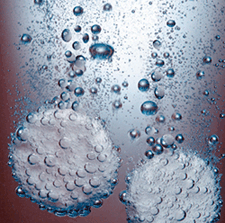
Dissolving aspirine
One of the most basic features that must be known about a drug is its solubility in water. When drugs are given most of them are in contact with some water-based biological fluid since the human body is mostly made up of water.
Solubility is a vital characteristic for the vast majority of drugs, but especially for those that are absorbed in the gastrointestinal (GI) tract. Thus, for example, an aspirin could not be absorbed in the small intestine even if it were split up into smaller fragments if it were not dissolved in the intestinal fluids.

In the case that a compound has no, or low solubility in water, the pharmaceutical formulator will try to increase its solubility. As a second alternative, a step back can be taken in this process and the compound can be sent back to a chemical laboratory where a salt form of the drug is synthesised. The compound solubility not only must be tested in aqueous media, but also in diverse acidic media, due to the fact that gastrointestinal fluids have diverse acidity levels.
In addition to water other non-aqueous solvents used in the final formulation of the drug must be evaluated such as glycerol, ethanol or propylene glycol, as well as solvents used in the manufacturing process like isopropyl alcohol, methanol and acetonitrile.

Sources: UTAustinX: UT.4.01x Take Your Medicine - The Impact of Drug Development.
              http://indacea.org/desarrollo-de-medicamentos-1/               
              Valentia Biopharma S.L.               
              http://www.pharmatechespanol.com.mx/articulo/820.polimeros_avanzados_para_mejora_de_la_solubilidad


Read more

2.1. Scanning tunneling microscope (STM)

0 comments
In the post titled “Nanotechonology. Introduction” I mentioned that the development of the scanning tunneling microscope played a fundamental role in the progress of nanotechnology, so let’s learn a little more about it and how it works.
The scanning tunneling microscope (STM) was developed by Gerd Binning and Heinrich Rohrer in 1981 at IBM laboratories in Zurich (Switzerland), for which they were awarded the 1986 Nobel Prize in Physics.
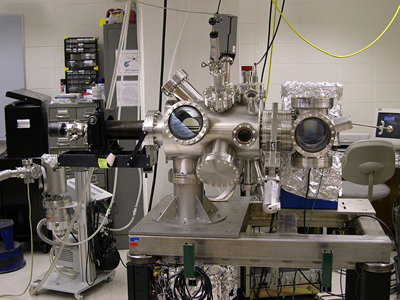
Scanning tunneling microscope
Both the STM and the AFM (atomic force microscope) are classified as scanning probe microscopy instruments, but the first is far more powerful and is able to handle and observe atoms and molecules with higher resolution.

The STM is used to take images of conductive surfaces at an atomic scale of around 2 Å (2*10-10 m). It can also modify the examined sample by manipulating individual atoms, setting off chemical reactions and originating ions by replacing electrons from certain atoms with others.

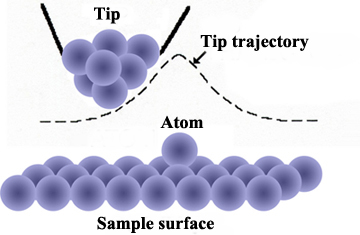
The scanning tunneling microscope is a non-optical microscope (it does not use rays of light to take us down to nano-dimensions) whose operation is based on quantum mechanic principles. An extremely fine probe is positioned over the specimen under study at a distance of the diameter of an atom, applying a voltage between them. Depending on the characteristics of that voltage, the electrons can jump from one side to the other by tunneling effect[1], producing a weak current flow, known as “tunneling current”, whose value is approximately a few picoamperes (1 pA = 10-12 A).
Trajectory of the probe tip over the sample
The stylus probe is very sharp, with a tip formed by a single atom. It scans the surface at a very slow speed, raising and lowering (by a piezoelectric mechanism[2] to control its level) in order to maintain a constant distance and signal, which permits the inspection of the tiniest detail of the sample that is being scanned.
The vertical movement of the stylus is registered allowing the inspection of the surface structure atom by atom, producing a contour map of the surface generated by a computer.

Electrical insulating materials cannot be analysed by this technique because, as their electrical charges do not flow freely it consequently makes it impossible to conduct any kind of current between them and the probe tip.

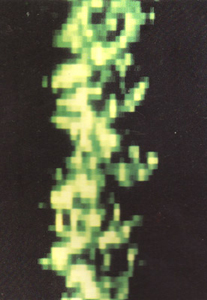
Parallel double-stranded DNA. Image obtained by STM
Although these instruments show an optimal operation examining conductive materials, they can also provide topographical characterisations of organic molecules such as DNA or proteins.

This type of microscope plays an important role in physics, specifically in the study of  semiconductor surfaces and in the field of microelectronics. It also proves to be important in chemistry, studying superficial reactions like catalysis or in nanoscale chemistry laboratories, where the analysis of the physical structure of synthetic chemical compounds and material defects is essential.


[1] The tunnel effect consists in those quantum particles (electrons in this case) that in spite of the fact of not having enough kinetic energy (energy associated with body motion), they penetrate and cross a space that, in principle, would be impossible, due to the presence of a potential barrier that should block their flow.
[2] Materials that are deformed through expansion or contraction, under the action of an electric field.

Sources: http://education.mrsec.wisc.edu/130.htm              
              http://www.nobelprize.org/educational/physics/microscopes/scanning/
              http://hoffman.physics.harvard.edu/research/STMintro.php
              http://www.uwec.edu/Matsci/center/instrumentation/


Read more

2.1. Introduction to nanomedicine

0 comments
The application of nanotechnology in the healthcare field has enabled the development of a new scientific discipline known as nanomedicine.

Due to the fact that some of the fundamental biological macromolecules of living organisms (like the DNA and proteins) are located at nanoscale, this has allowed the interaction between nanometric devices and nanomaterials within the human body. This has facilitated the discovery of important new advances in medicine.

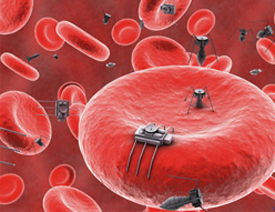
Certain predictions made in the early stages of the development of nanotechnology are still science fiction.
Imaginary nanobots in the bloodstream
For instance, the idea that we could develop “nanobots” that would protect us against external microorganisms, would cure injuries and damaged tissues selectively. Nevertheless, some major advances have been made.

The steady increase of neurodegenerative and cardiovascular diseases, diabetes or cancer  requires us to investigate new diagnostic and therapeutic techniques that must be simpler, quicker and more precise than the ones we have today, decreasing, at the same time, the costs involved. It is expected that nanomedicine should address some of these problems, like diagnosing disease at its earliest stage, tailored treatments for patients or the ability to regenerate damaged organs and tissues.

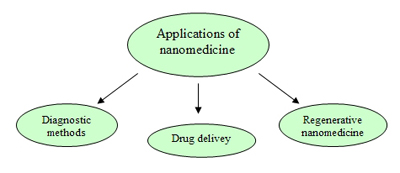
Nanomedicine is focused on three large areas: diagnostic methods, drug delivery systems and regenerative medicine. Nanodiagnostic techniques are divided into analysis systems and methods of medical imaging. Both methods enable the detection of the appearance of the disease, in vitro and in vivo at early stages.  This makes it possible to take action with the most appropiate treatment and causing as little damage as possible to the rest of the body.
Fields of applications of nanomedicine
In sample analysis of patients, nanomedicine also helps to achieve a more specific, quicker and more effective diagnosis. In this way diseases are diagnosed at cellular and molecular level providing more chance of a cure.
Nanomedicine has also advanced drug delivery systems: drugs are guided specifically to those affected areas and cells to accomplish a more effective treatment with a lower dose and minimising side effects. In addition, these systems protect the carried drug by avoiding degradation of the drug before it reaches its target. Thus, the challenges of  delivery associated with drugs with poor solubility or with those that cannot be delivered using conventional methods is solved.
Lastly, through gene and cell therapies, biomaterials, tissue engineering and nanotech tools, regenerative nanomedicine boosts the natural repairing mechanisms of the human body which often are not enough to achieve the total recovery of the organism alone.


Sources: Informe de vigilancia tecnológica: nanomedicina. Fundación para el conocimiento madri+d CEIM
              Nanomedicina: aplicación de la nanotecnología en la salud. Laura M. Lechuga.Grupo de Nanobiosensores y Aplicaciones Bioanalíticas
              Centro de Investigación en Nanociencia y Nanotecnología (CIN2). CSIC
              Fundación española para la ciencia y la tecnología (FECYT). Nanociencia y nanotecnología. Entre la ciencia ficción del presente y la                     tecnología del futuro, 2009.


Read more