
• Biology

    Biology

    The atom, biological macromolecules (carbohydrates, lípids, proteins, nucleic acids), cell biology, cancer

  • Drugs

    Drugs

    Drug development, pharmacodynamics, pharmacokinetics, toxicology

  • Nanomedicine

    Nanomedicine

    Introduction to nanotechnology, diagnostic devices, drug delivery, regenerative medicine

  • Miscellaneous

    Miscellaneous

    A more in-depth explanation of topics previously mentioned in the other sections

3.2. Carbohydrates

0 comments
Most people are more than familiar with the first type of biological macromolecules that I will explain: carbohydrates.
Carbohydrates are an essential part of our diet; they provide energy (4.3 Kcal/g) mainly through glucose. Among the rich natural sources of carbohydrates we find: vegetables, fruits and cereals. Their molecular structure is represented by the stoichiometric formula (CH2O)n, where “n” indicates the number of carbon atoms in the molecule. Therefore, in carbohydrate molecules the ratio C, H, O is always 1:2:1.
Carbohydrates are divided into three types: monosaccharides, disaccharides, and polysaccharides.


Monosaccharides

Monosaccharides (mono-: one; sacchar-: sweet) are simple sugars; glucose being the most common among them. Most of them are named by the suffix: “-ose”. They contain a number of carbon atoms that vary from three to seven. Thus, we find trioses (three carbons), pentoses (five carbons) or hexoses (six carbons).
Monosaccharides are molecules that can adopt both linear chain shapes and ring shapes; these ring forms are frequently found in aqueous solutions. If monosaccharides contain an aldehyde group[1], the monosaccharide is known as aldose, however if the functional group is a ketone group[1], the monosaccharide is called ketose.

The monosaccharide glucose (C6H12O6) is one of the basic energy sources for the human being. During cell respiration, glucose releases energy which is used to produce ATP (adenosine triphosphate)[2]. Plants synthesise glucose using CO2 and water, their surpluses are stored/accumulated as starch which is catabolised (broken down by cells) when it is consumed by the human being or herbivorous animals.

Among other monosaccharides, we can also point out galactose (which is part of lactose or milk sugar) or fructose (present in fruits and honey). Both glucose, galactose and fructose[3] are examples of isomeric monosaccharides because they have the same chemical structure but they differ structurally and chemically due to the different arrangements of their functional groups around their assymetric (or chiral) carbons[4]. Glucose and galactose belong to the group that we saw previously called aldoses and fructose belongs to the ketose group.
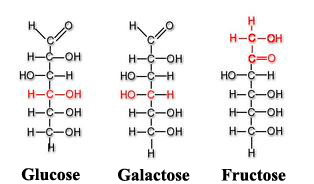
Glucose, galactose and fructose molecules

Disaccharides

Disaccharides (di-: two) are formed when two monosaccharides undergo a dehydration synthesis. During this process the hydrogen atom of one monosaccharide is combined with the hydroxyl group of other monosaccharide, forming a covalent bond between them and releasing a water molecule. This covalent bond is named glycosidic bond, which is classified in two types: α and β, depending on if the hydroxyl group is located above or below the chiral carbon (also known as asymmetric carbon that we saw previously).
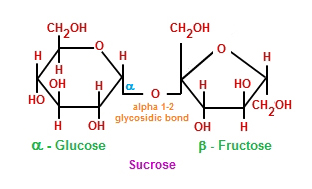
Sucrose molecule: combination of monosaccharides glucose and fructose
Among the most common disaccharides are found lactose, which is the result of the union of galactose and fructose. Milk is a natural source where lactose is found.  Another example of disaccharides is maltose, or malt sugar, which is formed during a dehydration reaction performed by two glucose molecules. But, without a doubt, the most common disaccharide is sacarose, or table sugar, made up of fructose and glucose monomers.


Polysaccharides

Polysaccharides (poly-: many) are long chains of monosaccharides joined by glycosidic bonds. These chains can be branched or unbranched, containing different types of monosaccharides.
Among the main polysaccharides are: cellulose, glucogen, starch and chitin.

Starch
As I mentioned earlier, plants are capable of synthesising glucose from water and CO2. When glucose production exceeds the energy needs of the plant, the surpluses/excesses are stored as starch in different parts of the plant like the root and seeds, providing feed during their germination.
When starch is consumed by animals or humans in their diets, it is first broken down by enzymes (such as salivary amylases) into smaller molecules like glucose, before being absorbed by cells to satisfy their energy needs.

Glucogen
Glucogen, composed of glucose monomers, is how glucose is stored in humans and other vertebrates. It is the equivalent to starch in plants and it is accumulated in muscular cells and the liver. When blood glucose levels decrease, these glucose deposits are demanded and glucogen is broken down into glucose during a process called glycogenolysis.
Glycogenesis and glycogenolysis processes

Cellulose
Cellulose, also made up of glucose monomers, is the most abundant polymer. It is the main element of plant cell walls, giving them structural support. In cellulose the basic monomers are tightly packed, giving cellulose its typical fibrous structure which confers stiffness and high tensile strength, i.e. structural support for plants.
Unlike human beings, herbivores have bacteria and protists[5] inside their digestive system which segregate the cellulase enzyme to help digest the cellulose they consume in their grass. By the action of this enzyme, cellulose is broken down into glucose monomers and in this way it can be used as energy source.
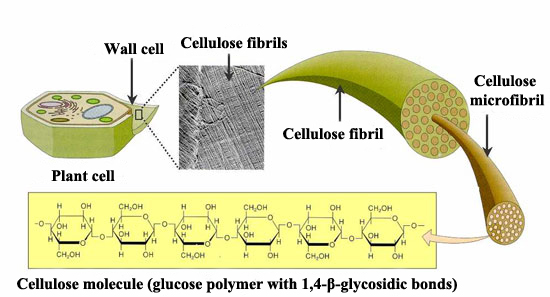
Cellulose structure

Chitin
The fourth polysaccharide to point out is chitin, which is the main component in fungi cell walls and the exoskeleton (external skeleton) of arthropods, which protects their internal organs. Chitin is a polysaccharide with a high nitrogen content, constituted by repetitive units of N-acetyl-β-glucosamine, a kind of modified sugar.


BENEFITS OF CARBOHYDRATES

Carbohydrates are composed of both soluble and insoluble elements. Among the insoluble carbohydrates we find fiber, which is mainly cellulose. Cellulose helps to regulate the intestinal transit and the glucose consumption rate. It also binds to the blood cholesterol in the small intestine and in this way the cholesterol is eliminated by being excreted from the organism in faeces. Also, diets high in fibre can help to protect against colorectal cancer.

Glucose is provided by the carbohydrates that we consume. Once it is broken down during cell respiration, glucose produces ATP molecules, known as the energy-currency of cells, providing fast energy for any organism.
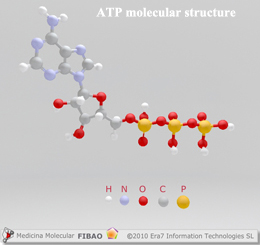
ATP molecular structure
Consequently, without the consumption of carbohydrates, the availability of instant energy for the body (or any other organism) would be deeply reduced.

For all these reasons, eliminating the ingestion of carbohydrates, like some hypocaloric diets recommend in order to achieve a fast weight loss, is questionably healthy. To accomplish such an aim, it would be more healthy to balance appropriate low GI carbohydrates present in vegetables, fruits and cereals with a balanced level of proteins, vitamins and lipids, a suitable water intake and doing exercise appropriate to our age, gender and physical fitness.


[1] Both are organic compounds characterised by containing the carbonyl functional group (C=O). But aldehydes contain the carbonyl group bonded to at least one hydrogen atom, whereas ketones contain the carbonyl group bonded to two carbon atoms.
[2] Molecule used by all living organism to provide energy in chemical reactions. It is considered as the “energy-currency” of the metabolism.
[3] They all are hexoses: six carbon atoms in their structures.
[4] Carbon atom attached to four different types of atoms or group of atoms.
[5] Eukaryotic (their cell nucleus is delimited by a membrane) organisms, usually unicellular, which due to their own characteristics cannot be included in the rest of the kingdoms (animals, plants and fungi) within this category.

Sources: OpenStax College, Biology. OpenStax College. 30 May 2013.              
              http://medmol.es/glosario/121012glosariomedmol_atp/
              https://kel-tay-lii.wikispaces.com/A.+Intro+to+Phys
              http://chemistry.tutorvista.com/organic-chemistry/oligosaccharides.html
              http://www.entrenasalud.es/glucogeno-y-deporte-un-gran-deposito-de-energia/
              http://www.asturnatura.com/articulos/envoltura-celular/pared-celular.php


Read more

3.1. Biological macromolecules. Introduction

0 comments
Within this section I will explain the four main types of biological macromolecules: carbohydrates, lipids, proteins and nucleic acids. These macromolecules are the basic constituents of cell structure, that in combining form most of the dry weight of a typical cell. They carry out a wide range of functions in cells. These macromolecules are organic molecules, thus their main component is carbon. Hydrogen (H), oxygen (O) and nitrogen (N) and other minor elements are also part of their structure.
The two fundamental reactions that control the synthesis of biological macromolecules are the following:

    ▣      Dehydration synthesis
The basic blocks of most macromolecules are sub-units known as monomers. These monomers are combined through covalent bonds to form larger molecules (polymers). To do this they release water molecules as byproducts, this mechanism is called dehydration synthesis, which means “to join by losing water”. During these reactions, the hydrogen (H+) of one of the monomers is combined with the hydroxyl group (OH-) of other monomer, releasing a water molecule. At the same time, the monomers share electrons and are joined by covalent bonds.
Different types of monomers or even just a single monomer is combined to form a diverse range of polymers. Thus, for instance, glucose monomers are the components of several different substances such as cellulose, glycogen or starch.
Dehydration reaction

    ▣      Hydrolysis
Hydrolysis (“to separate water”) is a reaction in which water molecules are used to break down the polymers into their basic monomers. In these reactions the polymers are divided in two: one part acquires a hydrogen atom (H+) and the other a hydroxyl group (OH-); both elements (H+ and OH-) occur from the breakdown of a water molecule.
Hydrolysis reaction
Both in hydrolysis and dehydration reactions, enzymes (a specific type of proteins) can act to catalyse (accelerate in these two cases) these reactions.
Through hydrolysis and using particular digestive enzymes, our body breaks down the proteins, lipids and carbohydrates (macromolecules) that we eat. Once these ‘macro’ (i.e. larger) molecules are broken down into smaller molecules, the intestinal cells can absorb the nutrients that they contain. Thus, for instance, lipids are metabolised by lipases, proteins are broken down by the action of hydrochloric acid, peptidase or pepsin and finally carbohydrates are digested by enzymes like lactase, maltase or sucrase.
By breaking down all these molecules into a unit where cells can absorb them as their own ‘food’, these cells obtain the necessary energy to perform all their functions.

Sources: OpenStax College, Biology. OpenStax College. 30 May 2013.               
              http://www.differencebetween.net/science/health/difference-between-hydrolysis-and-dehydration-synthesis/


Read more

1.2.4. Optimisation of candidates

0 comments
The number of pharmacological compounds that survive the screening phase has to be further reduced and optimised according to key criteria.
To accomplish the largest possible reduction in the number of drug candidates, researchers characterise the way the compounds bind to their targets. This optimisation process is therefore, only applied to the first technique we discussed previously, the target-based approach.
Due to the limited knowledge about the mechanism of action of the chemical compounds in the phenotypic approach, the validation of this optimisation process is quite hard to carry out using this method.
Among the main factors affecting drug-target binding, we find:

      Affinity degree between drug and target.

      How many different targets the drug can bind to.

      How long the chemical compound (drug) can be bound to the target.

These criteria will help to discover the most effective drug dose and detect any undesirable side effects that may occur.
Further, those candidates that present toxicity at therapeutic levels have to be eliminated, as well as those which are highly unstable in solution or solid state, and finally those which are highly expensive to synthesise.
The compounds that meet the necessary requirements are examined by chemists, who produce a certain type of compound called analogs, structurally similar but with improvements in the mentioned criteria.

One of the major tasks during the optimisation process is to determine the correlation between the chemical structure of the compound and its activity (QSAR[1]) and in what way the first factor affects the second one.
Another aspect to evaluate is compound’s drugability, which describes the ability of the drug to reach its target, bind to it and be capable of producing some measurable effect. To find out the drugability of a candidate, scientists use Lipinski’s rule of five, which establishes that an oral medicine fulfils its pharmacological function if:

      It does not contain more than five hydrogen bond donors (total number of nitrogen-hydrogen and oxygen-hydrogen bonds).

      It does not contain more than ten hydrogen bond acceptors (total number of oxygen or nitrogen atoms).

      Its molecular mass is less than 500 uma.

      An octanol-water partition coefficient[2] (log P) less than five.


[1] Quantitative structure-activity relationship is the process whereby the chemical structure of a compound is related to the biological activity of a receptor.
[2] Ratio between the concentration of a certain substance (solute) in two solvents in equilibrium (octanol and water): log P = log ( [solute]octanol / [solute]water ).

Sources: UTAustinX: UT.4.01x Take Your Medicine - The Impact of Drug Development.
              https://es.wikipedia.org/wiki/Relaci%C3%B3n_cuantitativa_estructura_actividad
              https://es.wikipedia.org/wiki/Coeficiente_de_reparto_octanol-agua


Read more

1.2.3. Screening candidates

0 comments
After the identification and a detailed study of the key target in the development of the disease, there is a second stage based on the screening or selection of the future drugs that will effectively perform on that causal target. This approach dictates the discovery of most marketed drugs presently.
In the selection of chemical compounds, scientists should have an accurate idea about what sorts of candidates are able to bind to the biological receptor in a suitable way, thus minimising the number of compounds that need to be initially screened. This number will be further decreased by the use of specialized software and virtual libraries that contain detailed knowledge about the different pharmacological compounds to be analysed.
Subsequently, the screening carried out in the laboratories uses automated equipment with multiwell plates (carrying the biological receptor), in these plates the performance of the different candidates to study is evaluated in a relatively short period of time.

In principle one would think that the better binding pharmacological compound-target is, the better the expected result should be, but this is not always the case, since knowing the mechanism of disease progression and the role of all its targets is nearly impossible. This is why researchers have developed an alternative approach to this problem, named the phenotypic approach. Using technique a living model[1] of the disease is used and scientists conduct research to see if the candidate has been able to reduce or eliminate the signs of the disease in some way, without knowing the targets and their mechanisms of action.
The main advantage of this method is its higher potential to discover first-class compounds, but not knowing the receptor makes it much harder to modify the chemical compounds. Also, it will be unknown how these likely modifications could affect the binding with the biological target.

Relatively recently, a new type of compounds called biologic compounds have been used, which rather than being produced in a chemical lab, originate from living systems.
Most of them are not going to bind to any targets because they are copies of existing molecules in our organism.
For example, insulin[2] has been produced by genetic engineering by introducing DNA in bacteria colonies. These bacteria grow, multiply and by reading the inserted human genetic code produce the insulin.
Some of these biological compounds can also perform over receptors, because tailor made proteins and antibodies can be designed to bind or interfere with those elements that cause diseases in cells.


[1] These living models are cells, cellular tissues or even mice developed to model human diseases.
[2] Hormone made up of 51 aminoacids, produced and secreted by pancreatic beta cells. It is in charge of regulating glucose levels in blood.

Source: UTAustinX: UT.4.01x Take Your Medicine - The Impact of Drug Development.


Read more

1.2.2. Identifying targets

0 comments
The development of a new drug is initiated with the identification and the selection of biological receptors (targets) on which that pharmacological compound will perform on. These targets are ordinarily proteins where the compound binds to produce changes in their functions.
Proteins are the workers which perform most of functions in human cells, consequently it makes sense that these are the places where drugs bind to transform their activities, modifying this activity will help to eliminate or, at least, reduce diseases in infected cells.
Genes can be a target for drugs as well, which are in charge of providing instructions about what proteins must be created and what tasks they will fulfil within the cell. These proteins and genes are not always human: it is estimated that around 15-20% of current medicines act on proteins and genes of the pathogen that has invaded our body and caused diseases.

The problem related to many diseases is the fact that hundreds of genes and proteins can be involved in their progression, that is the reason why the selection of the key receptor by the researchers is a fundamental factor.
To carry out this task it is essential to statistically analyse a huge amount of data to be able to choose the most suitable biological target for the chemical compound.

On some occasions, just the binding between a drug and a target is enough to eliminate a disease. For instance, amoxicillin antibiotic binds certain proteins on cell walls of the infectious bacteria, leading to the breakdown of these walls and therefore, the death of these bacteria. However, it is not always so easy, since those bacteria that have developed antibiotic resistance have been able to modify the receptors where drugs perform, losing, in this way, their therapeutic action.
Often, other diseases are really hard to overcome because they are caused by a combination of genetic, environmental factors and lifestyle factors: Alzheimers being one example.
Lastly, at other times, it may be more appropriate to adopt a “multi-target” approach where several drugs are administered to a single receptor, where a single drug performs on multiple targets, or a combination of both techniques.

Source: UTAustinX: UT.4.01x Take Your Medicine - The Impact of Drug Development.


Read more

1.2.1. Introduction to drug discovery. Prediscovery of targets

0 comments
In past, research into new drugs was accomplished in a very different way to today. Many of these drugs were simple homemade remedies, which were passed on from generation to generation and most of them discovered by accident. This is the case for one of the most famous antibiotics ever: penicillin. 
In 1928, Alexander Fleming observed that a staphylococcus bacteria culture that he was studying was
contaminated by a certain fungus (penicillium) and that the area around these fungi was free from bacteria. It was later on, Howard Floyd who realised the tremendous potential of penicillin for wounded soldiers during the II World War.
Although these kinds of discoveries still occur today, they are not as usual as they used to be and tend to have less impact than penicillin had at the time. Currently a much more methodical process is followed which involves industry, universities, government agencies and even philanthropic organisations. The development of drugs begins with the discovery of new drugs, which starts with approximately 10,000 potential candidates of which 9,999 will be ruled out until the best of these compounds is selected. The chosen candidate will have a suitable equilibrium between efficacy and safety. The discovery phase can also be broken down in four stages:

      The pre-phase of research about the disease on which the future drug will act.

      Identifying a target disease where onto the drug can bind (known as biological or therapeutic target).

      Screening of the chemical compounds that perform on these targets.

      Optimization of these compounds until they produce the lead candidate.
Drug development stages


PREDISCOVERY OF TARGETS

As you could see from my previous post in this section, drug development is a really long process with high costs both in terms of human effort and financial investment. You can imagine then that before beginning this process we need to answer a set of questions to give us a clear idea about the next steps to take:

      What are the unmet medical needs today, what drug can be developed that allows us to establish a solution to a certain disease whose treatment or cure does not exist or is deficient currently.

      To have a broad knowledge about the illness which the drug will work on. This knowledge includes the causes of the disease, which is not always trivial.

      What proteins and genes are altered by the disease and how that affects the way in which these genes encode proteins.

      How cells and tissues are also modified.

      Finally, how the disease affects the whole patient.

Hence, this is a study from the smallest target where the disease can act (proteins and genes) to the largest (the patient).

Sources:  UTAustinX: UT.4.01x Take Your Medicine - The Impact of Drug Development.
               UC San Diego: Drug Discovery, Development & Commercialization.


Read more