• Biology

    Biology

    The atom, biological macromolecules (carbohydrates, lípids, proteins, nucleic acids), cell biology, cancer

  • Drugs

    Drugs

    Drug development, pharmacodynamics, pharmacokinetics, toxicology

  • Nanomedicine

    Nanomedicine

    Introduction to nanotechnology, diagnostic devices, drug delivery, regenerative medicine

  • Miscellaneous

    Miscellaneous

    A more in-depth explanation of topics previously mentioned in the other sections

1.1. Nanotechnology. Introduction

0 comments
It is very likely that the term nanomedicine has caught your eye and maybe this is the first time you have heard of it. As nanomedicine can be defined as the application of nanotechnology in the medical field, I will begin this section with a brief view about what nanotechnology is. I will show you the unique features of technologies and materials at nanoscale and a classification of the most common types of structures used in nanomedicine.

But first of all, what is a nanometre?, the prefix “nano” comes from the Greek νάνος, which means “dwarf”. Nowadays, it indicates the billionth part or, in other words, it is a factor of 10-9, therefore, a nanometre (nm) is one billionth of a meter. This way, we can conclude that nanoscience/nanotechnology is the science/engineering that studies and operates with matter in a size from 1 to 100 nm.

The idea and concept of nanotechnology arose from a Richard Feynman’s conference at UCLA University in 1967, where this theoretical physicist introduced, for the first time, the possibility of manipulating atoms and molecules.
But nanotechnology age really began in 1981 when the scanning tunneling microscope (STM) was developed with which we are capable of observing atoms.
The smallest objects we can observe with our naked eye have a size around a millimetre (the thousandth part of a meter), e.g.: the edge of a coin or a grain of sand, below this magnitude we find it difficult to distinguish objects.
If we divide a millimetre into a thousand parts we are in the micrometer scale, which is the domain of bacteria (5-20 μm) or blood cells (red blood cells: 6-10 μm). Therefore, to observe them we need the help of an optic microscope.
If we keep decreasing the scale and we cut up a micrometer into a thousand parts, we achieve our goal: the nanometre, as I said previously the billionth part of a meter. At this scale we find viruses (20-250 nm) and the DNA molecule (around 2 nm wide).
However, to be able to observe an atom we should still decrease one order of magnitude our scale, as atoms have magnitudes from 0.1 to 0.3 nm.
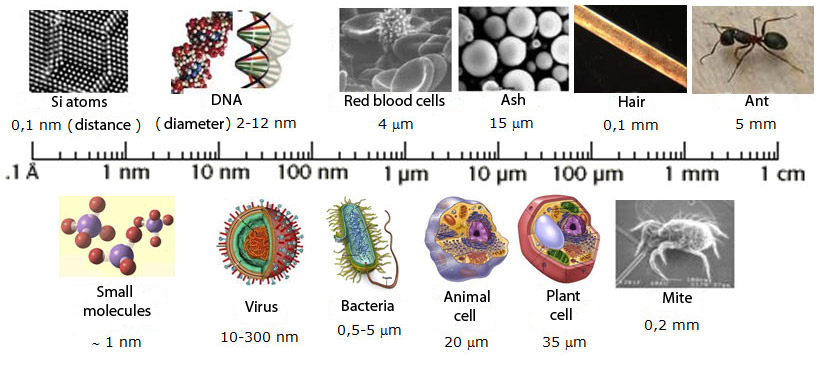
The scale of things
To get a more accurate idea about the real size of a nanometre, here are a couple of objects from our daily life measured in nanometres: a human hair is about 50,000-100,000 nm in diameter and a paper sheet is around 100,000 nm thick. Now, let’s do it the other way round, imagine you are shrunk until 10 nm, at that scale a human hair is like the island of Manhattan, a red blood cell like a football stadium, a polio virus like a basketball hoop and a hydrogen atom like a ping-pong ball…...¿surprising?

Right now, you may be wondering what the point is of using such tiny scales and you can find the answer, for instance, in your mobile phone. Miniaturisation has transform the huge, old mobile phones into small computers (with GPS, Internet connection, digital camera…) that you can carry in your pocket.
Nanotechnology has also enabled several breakthroughs like remote medical diagnostic devices, holograms, flexible and 3D screens, or seamless voice control devices.
Therefore, miniaturisation has allowed to locate millions of electronic devices in an area of just a few millimetres.


Surface area to volume ratio

One of the most important properties at nanoscale is the surface-volume ratio. This ratio is an essential parameter in miniaturization and nanotechnology, which states that this ratio increases as we decrease the dimensions of an object and vice versa.
As a material size diminishes, most of its atoms are located on the surface. Let’s consider a 10 nm silicon[1] cube, if we make some calculations we find that it contains around 50,000 atoms in all, of which 680 are located on each face of the cube. So, the overall number of atoms on the surface, multiplying by six, comes to 4,080. Now, if we divide this number by the total amount (50,000 atoms) we obtain that around 8% of the atoms are on the cube surface.
Let’s carry out the same calculations with a 10 cm2 and 1 μm thick cube, we get, in this case, that only 0.03% are found on the surface.
Therefore, from these calculations we can conclude that nanomaterials have a greater surface area per unit volume than larger materials. This ratio leads us to a really interesting property in materials at nanoscale: they are much more reactive from a chemical point of view, so they can catalyse reactions more easily, why? because atoms and molecules on surfaces do not have full allocation of covalent bonds, consequently, they are energetically unstable what makes them be more reactive than the non-nanoscale materials.

Because their specific physicochemical properties, nanomaterials have innumerable applications since they can participate in biological processes interacting with biological macromolecules (such as carbohydrates, nucleic acids, lipids and proteins). Also with ions, minerals, water in desalination treatments or even in drug delivery on which particularly I will focus on later.
Hence, there is a paradigm shift in nanotechnology: what is important about materials is not really what they are made of, but how small they are.


[1] Compound of oxygen and silicon ordered in a three-dimensional structure forming quartz and its types.

Sources: Introduction to Nanotechnology, Prof. Hossam Haick, Israel Institute of Technology.
              Rice University. Nanotechnology: The basics.
              http://www.quimicaviva.qb.fcen.uba.ar/v11n3/castro.html


Read more
1.1. Drug development. Overview

0 comments
First of all, to begin this section I would like to describe a brief overview about the different phases in drug development that we will study in more detail as we move forward.
Drugs are one of the substances that we are more familiar with in our daily life and we consume them more or less often depending on our health condition. However, very few people know their manufacturing process and the huge effort needed so that they can reach the market and our hands.
All around the world there are thousands of research teams analysing diseases and trying to find out their origins and causes. Once causes have been found, biopharmaceutical companies start to investigate how they can act to stop them or even revert their advance. To accomplish this goal tens of thousands of compounds are tested, whose origin can be:

      Natural: from substances that already exist in nature like morphin (plant origin), penicillin (microbial origin) or trabectedin (anti-tumor drug of marine origin).

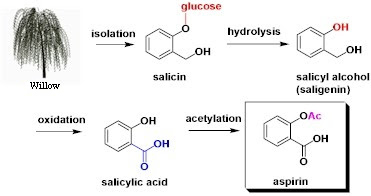
      Semisynthetic: compounds obtained in the lab like acetylsalicylic acid, synthesised from willow bark.
Aspirin manufacturing process

      Synthetic: compounds like ibuprofen with a complete chemical synthesis.

      Biotechnological: these drugs are manufactured with biotechnological techniques where the genetic material of bacteria is modified to produce substances with pharmaceutical interest such as human hormones (insulin) or antibodies.

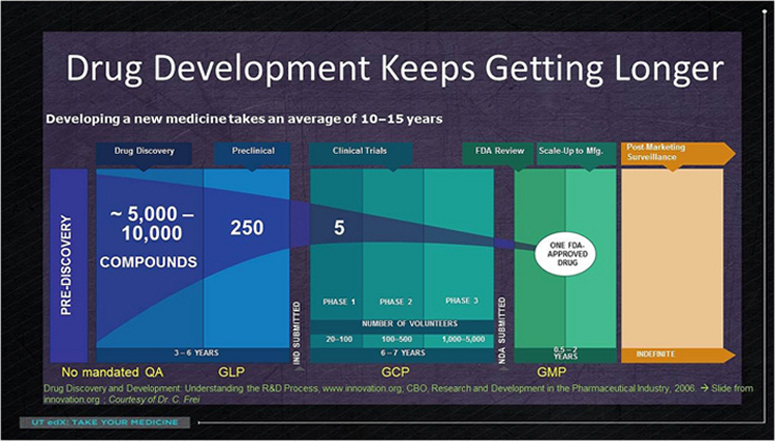
Through a hard and long screening process, that can take over six years, just a few drug candidates are selected (around 10 out of 10,000 initial substances).
All the information about their toxicity and activity in cells and experimental animals is gathered (this phase is called “preclinical phase” where good laboratory practices are followed: GLP). With this information the company requests authorization a drug regulatory agency to initiate the clinical trials. If this authorization is given, the drug candidates are subject to a clinical trial (according to the good clinical practice guidelines: GCP) divided into three stages. Due to the emphasis on safety and effectiveness not all candidates cannot move beyond this long process successfully. These three stages are the following:

      In phase 1 the drug is tested on human beings for the first time. Small trials, which are focused on safety and how the drug is distributed in the body, are performed on healthy volunteers.

      In phase 2 the trial is conducted at a larger scale on volunteers actually suffering from the disease of interest. In this stage the main concern is drug effectiveness and the right doses.

      In phase 3 the trials are carried out on a large number of people in order to enhance the acquired knowledge in the former phase with a larger and broader range of people, involving a lot more money as well.
Drug development phases
If the clinical trial succeeds, which takes around 6-7 years, the biopharmaceutical company processes a new application that will be reviewed thoroughly for a long period of time.
Once the evaluation is over, only safe and effective drugs will be authorised for public use, but despite this approval the regulatory agency will keep monitoring the drug in the market.
Not only during the preclinical and clinical stages strict regulations are followed, but also during the manufacturing process. These rules and regulations are known as GMP guidelines (good manufacturing practices).
Although the final result of this process can be as simple as taking a pill with some water twice a day, it requires a total period of time from 12 to 15 years, an investment between $1-$2 billion and thousands of people who are involved to develop a single drug.

Source: UTAustinX: UT.4.01x Take Your Medicine - The Impact of Drug Development.


Read more

2.4. Atomic physics

0 comments
Bohr atomic model was one of the first classic atomic models where the electrons orbit at specific distances from the atomic nucleus, like the planets orbit around the Sun.
This model can explain the reactivity and chemical bonds in certain elements, but it is just an approximate model because the electrons are not located in orbits but in atomic orbitals. 
These atomic orbitals are regions of space where the probability of finding an electron is greater according to the mathematical equations of quantum mechanics (Schrödinger equation). These atomic orbitals, with complex shapes, arise from the fact that electrons does not behave only as particles, but also as waves. Therefore, the term "orbit" in Bohr model is replaced by "atomic orbital" in this quantum-mechanic description.

Now, I will explain some concepts about quantum mechanics, but do not worry, I will try to do it in a simple and concise way.
Quantum mechanics establishes that to know an electron state in an atom (where that electron is in space), it is necessary to know the value of four quantum numbers, each one indicates a different property for that electron:

      Principal quantum number (n): indicates the orbital energy, the shell and the average distance between an electron and the nucleus. Its value goes from 1 to the shell containing the outermost electron of that atom, n = 1, 2, 3....

      Angular or azimuthal quantum number (l): describes the orbital shape. Its value depends on the former one (n), and it goes from 0 to n-1, l = 0, 1, 2,.....n-1.

l valueType of orbitalOrbital shapes
1sSpherically shaped
2pDumb-bell shaped
3dMost butterfly shaped
4fExotic and complex


      Magnetic quantum number (ml): characterises the orientation of the atomic orbital in space according to the axes X, Y and Z. It also depends on the former quantum number (l), the values ranges from –l to +l, with integer steps, including zero.

      Electron spin quantum number (ms): unlike the others, it does not depend on another quantum number; ms has just one of the two following values: +1/2 and -1/2. These two numbers tell us the two possible spin movements of an electron: clockwise and anticlockwise.

NameQuantum numberAllowed values
Principal quantum numbern1, 2, 3...
Angular or azimuthal quantum numberl0, 1, 2, 3...n-1
Magnetic quantum numberml-l, (-l+1)...0...(l+1), l
Electron spin quantum numberms1/2, -1/2

So, the general idea you get from all this is that to describe an electron you need four properties that are indicated by four numbers, it is as if we would like to characterise an article of clothing with four features. Let’s say for example:
      Design (to know if it is a shirt, a scarf, a skirt, a pair of trousers…)
      Size (to know if it is an article of clothing for children, teenagers or adults)
      Color (blue, red, white…)
      Type of fabric (nylon, wool, cotton…)
Once we have all this information we can know what an article of clothing we are talking about. In the same way, once we know the four quantum numbers we can find out what electron we are referring to and where it is.

As we move forward along the periodic table the number of electrons in each element is increased by one unit in accordance with two principles, those are Pauli exclusion principle and Hund’s rule:

      The first one states that in the same atom, two electrons cannot have identical values for all four of their quantum numbers, in other words, two electrons cannot be in the same quantum state. If this principle were not true, the chemical behaviour of elements, and hence also nature, would be completely different from the way in which we know it.

      On the other hand, Hund’s rule states that in the same atomic orbital, electrons fill it in such a way that these electrons tend to be unpaired.
Making an analogy, we could say that electrons behave like people getting on a bus. You will have noticed that we prefer to sit without anyone next to us, and only when we do not have a chance to do it, it is when we sit next to someone else. Like electrons, in the same atomic orbital, we would rather be “unpaired” on a bus.
Let's consider the nitrogen atom which electron configuration[1] is 1s22s22p3, whose electrons are arranged as follows:
Hund's rule applied to the nitrogen atom
As you can observe, the electrons in p orbital prefer to be unpaired, since all the orbitals in a shell (in our case, p orbitals in shell 2) must be occupied by, at least, one electron before a second electron is added. This fact, explained by Hund's rule, occurs so that the atom is more stable energetically.


[1] It is the distribution of electrons of an atom in each energy level and atomic orbitals.

Source: McGraw-Hill, Física Raymond A. Serway, 1993.
            McGraw-Hill, Química Raymond Chang, 1992.


Read more

2.3. Chemical bonds

0 comments
A chemical bond is defined as a force that joins two or more atoms from the same or different element to build more complex structures: molecules. Among the main bonds that form the biological macromolecules, which we will study in-depth later, we can find:

      Ionic bonds: between ions with opposite charges. An illustrative example of this kind of bond is represented by sodium chloride molecule (NaCl), commonly known as table salt. This molecule is formed by ionization[1] of sodium atom (Na) and chlorine atom (Cl), and the attraction of resulting ions.
Formation of sodium chloride molecule

      Covalent bonds: the electrons are shared between atoms to form bonds and satisfy the octet rule[2]. Within covalent bonds we can find two subtypes:

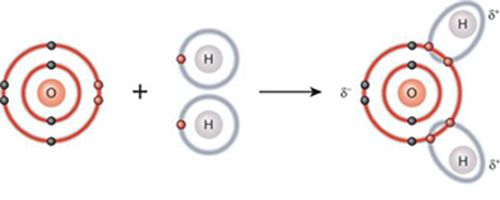
1.     Polar covalent bonds: the electrons are unequally shared by the atoms in such a way that they are more attracted by one of the nuclei than by the other (they have different electronegativity). Hence, one side of the molecule is slightly negative (δ-) and the other slightly positive (δ+). An example is water molecule where the oxygen atom is negative charged and the two hydrogen atoms are positive charged.
Water molecule
2.     Nonpolar covalent bonds: are formed by two atoms where the electrons are shared equally. Molecular oxygen (O2) is an example where the electrons are distributed evenly.

      Hydrogen bonds: weak interactions between hydrogen atoms (slightly positive) and other atoms (usually nitrogen and oxygen) from the same or different molecule. They are in charge of zipping together the two strands of the DNA double helix molecule.

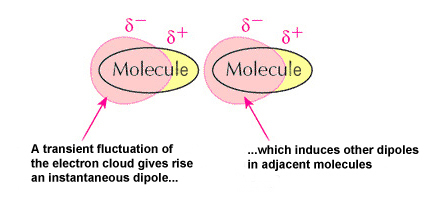
      Van der Waals interactions: weak interactions or attractions between molecules due to the fact that two or more of them depend on slight fluctuations of the electronic densities[3], which are not always symmetrical around the atoms. This kind of interaction contributes with ionic, covalent and hydrogen bonds to the three-dimensional structure of proteins.
Formation of Van der Waals interactions


    [1] Process by ions are produced.
    [2] It establishes that those atoms with eight electrons in their outermost shell or valence shell are more stable from an energetic point of view.
    [3]  Probability of finding an electron in a certain region of space.

    Source: OpenStax College, Biology. OpenStax College. 30 May 2013.


    Read more

    2.2. Some chemical definitions

    0 comments
    Next, I would like to explain some basic definitions that I consider you should know to understand some concepts that we will see later. You may already know them as they are basic notions about chemistry that we all study at school, but I would like to brush up on them just in case:

          Atomic number: indicates the number of protons in an element. It helps us to distinguish elements from one another

          Mass number: is the addition of the number of protons and number of neutrons (electrons are ignored).

          Isotopes: those atoms of the same element that contain equal number of protons but unequal number of protons.

          Atomic mass: calculated from mass numbers of several isotopes that are from the same element. I’ll give you an example to clarify:
    Gallium is a chemical element with two isotopes 69Ga  and  71Ga whose relative abundances are 60.2% and 39.8%, so the atomic mass is:
    Gallium atomic mass = [ (69*60.2) + (71*39.8) ] / 100 = 69.7 u (being u: atomic mass unit, which is approximately the mass of one nucleon, either a single proton or neutron).

          Radioisotopes: those isotopes with a more stable electronic configuration by means of the emission of protons, neutrons and/or electrons.

          Periodic Table: table where the elements are organised according to their atomic number and distributed in rows and columns conforming to shared physical and chemical properties.


          Ions: those atoms that are more stable when they gain or lose electrons. In the first case, they are named anions or negative ions (e.g.: fluoride (F-), sulfide (S2-), and in the second they are called cations or positive anions (e.g.: sodium (Na+), lead (Pb2+)).

          Molecule: two or more atoms joined by chemical bonds.

          Chemical reaction: it occurs when two or more atoms are joined by bonds to form a molecule or when joined atoms are broken down.

          Reactives: substances used at the beginning of a chemical reaction, normally on the left side of the reaction.

          Products: subtances resulting from the end of a reaction, usually on the right side of a reaction.

          Electronegativity: tendency of an atom nucleus to attract electrons. It increases as we move to the top and right along the periodic table.
    Chemical reaction diagram


    [1] Partículas que constituyen el núcleo atómico: protones y neutrones.

    Source: OpenStax College, Biology. OpenStax College. 30 May 2013.


    Read more

    2.1. Introduction to the atom. Its structure

    0 comments

    Life, at its most fundamental level, is made up of matter that can be defined as any substance that takes up space and has mass.
    We will begin our study of biology with the most basic element of matter: the atom, we will get to know its structure, types, properties and how they arrange, by means of bonds, to form configurations with a higher level of complexity, which are named molecules.
    Atoms are the basic structural components of chemical elements, which can be described as unique forms of matter with specific physical and chemical properties that cannot be broken down (by ordinary chemical reactions) into smaller substances.

    Elements are named by a capital letter or two letters, when the first one has already been taken by another element, these letters are called chemical symbols. Thus, for example: H is the chemical symbol for hydrogen and He is the chemical symbol for helium.
    The four most common elements in living organisms, including human being, are oxygen (O), carbon (C), hydrogen (H) and nitrogen (N), whose percentages are:

    Element Percentage in living organisms
    Oxygen 65%
    Carbon 18%
    Hydrogen 10%
    Nitrogen 3%

    As I have just mentioned, the structural components in elements are called atoms, which are the smallest units of matter that retain all the chemical properties of an element.
    We can distinguish two different areas in an atom:

             The nucleus which is the centre of the atom made up of protons (p) and neutrons (n).

             The electrons (e-) in orbit around the nucleus, this is the outermost region in an atom.

    Protons and neutrons have, approximately, the same mass: 1.67*10-24 g, but they differ in their electrical charges, whereas protons are positively charged, neutrons are uncharged. Electrons, however, have a very low mas: 9.11*10-28 g, around 1/800 of an atomic mass unit[1]. Therefore, their largest contribution is not to the atomic mass but to its charge, since this charge is equal to protons’ but with opposite sign (negative).
    Interestingly, due to the tiny size of all these particles, most of the atomic volume is empty space ( > 99%), to give you an idea about what this means let’s imagine that our atom is a huge sphere around The Eiffel Tower (301 metres height), proportionally, the nucleus would be represented by a cherry stone and the electrons would be pinpoints around it. 

    As a result of this enormous vacuum, you can wonder why solid objects are impenetrable and this is on account of the fact that the electronic shells repel (negatively charged) each other.


    [1] Atomic mass unit (u) or dalton (Da) is approximately the mass of one nucleon, either a single proton or neutron and is defined as one twelfth of an unbound neutral atom of carbon-12 and has a value of 1.660*10-27 kg.

    Source: OpenStax College, Biology. OpenStax College. 30 May 2013.


    Read more