• Biology

    Biology

    The atom, biological macromolecules (carbohydrates, lípids, proteins, nucleic acids), cell biology, cancer

  • Drugs

    Drugs

    Drug development, pharmacodynamics, pharmacokinetics, toxicology

  • Nanomedicine

    Nanomedicine

    Introduction to nanotechnology, diagnostic devices, drug delivery, regenerative medicine

  • Miscellaneous

    Miscellaneous

    A more in-depth explanation of topics previously mentioned in the other sections

1.2.3. Screening candidates

0 comments
After the identification and a detailed study of the key target in the development of the disease, there is a second stage based on the screening or selection of the future drugs that will effectively perform on that causal target. This approach dictates the discovery of most marketed drugs presently.
In the selection of chemical compounds, scientists should have an accurate idea about what sorts of candidates are able to bind to the biological receptor in a suitable way, thus minimising the number of compounds that need to be initially screened. This number will be further decreased by the use of specialized software and virtual libraries that contain detailed knowledge about the different pharmacological compounds to be analysed.
Subsequently, the screening carried out in the laboratories uses automated equipment with multiwell plates (carrying the biological receptor), in these plates the performance of the different candidates to study is evaluated in a relatively short period of time.

In principle one would think that the better binding pharmacological compound-target is, the better the expected result should be, but this is not always the case, since knowing the mechanism of disease progression and the role of all its targets is nearly impossible. This is why researchers have developed an alternative approach to this problem, named the phenotypic approach. Using technique a living model[1] of the disease is used and scientists conduct research to see if the candidate has been able to reduce or eliminate the signs of the disease in some way, without knowing the targets and their mechanisms of action.
The main advantage of this method is its higher potential to discover first-class compounds, but not knowing the receptor makes it much harder to modify the chemical compounds. Also, it will be unknown how these likely modifications could affect the binding with the biological target.

Relatively recently, a new type of compounds called biologic compounds have been used, which rather than being produced in a chemical lab, originate from living systems.
Most of them are not going to bind to any targets because they are copies of existing molecules in our organism.
For example, insulin[2] has been produced by genetic engineering by introducing DNA in bacteria colonies. These bacteria grow, multiply and by reading the inserted human genetic code produce the insulin.
Some of these biological compounds can also perform over receptors, because tailor made proteins and antibodies can be designed to bind or interfere with those elements that cause diseases in cells.


[1] These living models are cells, cellular tissues or even mice developed to model human diseases.
[2] Hormone made up of 51 aminoacids, produced and secreted by pancreatic beta cells. It is in charge of regulating glucose levels in blood.

Source: UTAustinX: UT.4.01x Take Your Medicine - The Impact of Drug Development.


Read more

1.2.2. Identifying targets

0 comments
The development of a new drug is initiated with the identification and the selection of biological receptors (targets) on which that pharmacological compound will perform on. These targets are ordinarily proteins where the compound binds to produce changes in their functions.
Proteins are the workers which perform most of functions in human cells, consequently it makes sense that these are the places where drugs bind to transform their activities, modifying this activity will help to eliminate or, at least, reduce diseases in infected cells.
Genes can be a target for drugs as well, which are in charge of providing instructions about what proteins must be created and what tasks they will fulfil within the cell. These proteins and genes are not always human: it is estimated that around 15-20% of current medicines act on proteins and genes of the pathogen that has invaded our body and caused diseases.

The problem related to many diseases is the fact that hundreds of genes and proteins can be involved in their progression, that is the reason why the selection of the key receptor by the researchers is a fundamental factor.
To carry out this task it is essential to statistically analyse a huge amount of data to be able to choose the most suitable biological target for the chemical compound.

On some occasions, just the binding between a drug and a target is enough to eliminate a disease. For instance, amoxicillin antibiotic binds certain proteins on cell walls of the infectious bacteria, leading to the breakdown of these walls and therefore, the death of these bacteria. However, it is not always so easy, since those bacteria that have developed antibiotic resistance have been able to modify the receptors where drugs perform, losing, in this way, their therapeutic action.
Often, other diseases are really hard to overcome because they are caused by a combination of genetic, environmental factors and lifestyle factors: Alzheimers being one example.
Lastly, at other times, it may be more appropriate to adopt a “multi-target” approach where several drugs are administered to a single receptor, where a single drug performs on multiple targets, or a combination of both techniques.

Source: UTAustinX: UT.4.01x Take Your Medicine - The Impact of Drug Development.


Read more

1.2.1. Introduction to drug discovery. Prediscovery of targets

0 comments
In past, research into new drugs was accomplished in a very different way to today. Many of these drugs were simple homemade remedies, which were passed on from generation to generation and most of them discovered by accident. This is the case for one of the most famous antibiotics ever: penicillin. 
In 1928, Alexander Fleming observed that a staphylococcus bacteria culture that he was studying was
contaminated by a certain fungus (penicillium) and that the area around these fungi was free from bacteria. It was later on, Howard Floyd who realised the tremendous potential of penicillin for wounded soldiers during the II World War.
Although these kinds of discoveries still occur today, they are not as usual as they used to be and tend to have less impact than penicillin had at the time. Currently a much more methodical process is followed which involves industry, universities, government agencies and even philanthropic organisations. The development of drugs begins with the discovery of new drugs, which starts with approximately 10,000 potential candidates of which 9,999 will be ruled out until the best of these compounds is selected. The chosen candidate will have a suitable equilibrium between efficacy and safety. The discovery phase can also be broken down in four stages:

      The pre-phase of research about the disease on which the future drug will act.

      Identifying a target disease where onto the drug can bind (known as biological or therapeutic target).

      Screening of the chemical compounds that perform on these targets.

      Optimization of these compounds until they produce the lead candidate.
Drug development stages


PREDISCOVERY OF TARGETS

As you could see from my previous post in this section, drug development is a really long process with high costs both in terms of human effort and financial investment. You can imagine then that before beginning this process we need to answer a set of questions to give us a clear idea about the next steps to take:

      What are the unmet medical needs today, what drug can be developed that allows us to establish a solution to a certain disease whose treatment or cure does not exist or is deficient currently.

      To have a broad knowledge about the illness which the drug will work on. This knowledge includes the causes of the disease, which is not always trivial.

      What proteins and genes are altered by the disease and how that affects the way in which these genes encode proteins.

      How cells and tissues are also modified.

      Finally, how the disease affects the whole patient.

Hence, this is a study from the smallest target where the disease can act (proteins and genes) to the largest (the patient).

Sources:  UTAustinX: UT.4.01x Take Your Medicine - The Impact of Drug Development.
               UC San Diego: Drug Discovery, Development & Commercialization.


Read more

1.3. Top-down and bottom-up approach

0 comments
Current manufacturing technology is based on the approach known as “top-down” which consists of, in a similar way to a sculptor does, starting from a large block and shaping and chiseling it, to obtain, progressively, a smaller object with a desired shape.
In the nano approach, we progress in the opposite way, from the small structure, building up to a bigger one. This method is called the “bottom-up” approach, in which like lego (with a large number of pieces with different shapes, colours and size), we are going to begin with basic elements such as atoms, nanoparticles, nucleic acids or proteins to assemble molecules or even to build diverse sensors and devices.
To enable manufacturing using nanotechnology, special tools which enabled the visualization as well as the manipulation of objects at nanoscale are required. The scanning probe microscopy (SPM), for instance, accomplishes this task by allowing us not only to observe but also to move atoms on a surface.

The progress of nanoscience and nanotechnology and the use of this highly advanced instrumentation created one of the most significant features of this field: it is multidisciplinary. By reducing the scale, atoms and molecules become the basic “bricks” which physicist, chemists, biologists and engineers work with, using a common language. One example of this multidisciplinarity is the design and manufacturing of a biosensor where a biologist must have knowledge of quantum physics and a physicist about biology in order to design their end product successfully.

Assembly on a molecular or particle basis to develop all the technology we demand may seem unrealistic, nevertheless this is what the Earth has been doing for the last 4 billion years, since starting from simple molecules it formed really complex structures by linking and auto-assembling substances. Any living organism is, undoubtedly, a clear example of bottom-up building; starting from certain organic molecules and a genetic sequence it has been possible to create very complex structures functionally and structurally. As a consequence, nanotechnology can learn from these processes to imitate and adapt them, even, to other kinds of problems very different to biology.

The development of nanoscience and nanotechnology, according to experts, will occur in three stages. The firt one between the years 2000 and 2020, where industries will mainly keep using conventional production techniques (top-down). The second stage between 2010 and 2030, where bottom-up methodology will begin to spread, and ultimately become the leading manufacturing scheme for the rest of the XXI century. But this fact does not mean that our current procedures will totally disappear, because the use of one system or the other will be dependent on many factors like raw materials, labour, environmental and social costs and, of course, economic profitability.
Nanotechnology is already a major industry, worth 50 billion dollars globally market in 2006, with expected growth to a trillion dollars in 2015. Therefore, this market will benefit those companies whose countries are investing in this field long term.


Sources: Fundación española para la ciencia y la tecnología (FECYT). Nanociencia y nanotecnología. Entre la ciencia ficción del presente 
              y la tecnología del futuro, 2009.
              http://researcher.watson.ibm.com/researcher/view_group_subpage.php?id=4252
              http://www3.nd.edu/~kamatlab/facilities_physchar.html


Read more

1.2. Nanostructures

0 comments
Nanostructures can be defined as those objects where, at least one of their dimensions is located at nanoscale (1-100 nm). Among the most commonly used structures in nanomedicine field we find:

      Micelles: structures with spherical or globular shape. They are made of molecules that have a polar or hydrophilic head (with strong affinity for water) and a non-polar or hydrophobic tail (repels water). The heads are placed in the outer region of the micelle forming a layer in contact with the liquid environment surrounding it; the tail, instead, is located in the interior forming the nucleus of this nanostructure.
Their typical size is c50 nm and they are used to carry and deliver water-insoluble drugs, which are confined inside the hydrophobic core of the micelle, in such a way that they are protected from the exterior aqueous environment.
One of their most interesting features is that they can circulate through the bloodstream for longer than other sorts of particles because they can avoid macrophage[1] action.

      Liposomes: closed vesicles made up of lipid bilayers (two lipid layers faced by their hydrophobic tails). According to the number of these bilayers the liposomes may be classified as unilamellar or multilamellar.
Unilamellar liposomes are characterised by an aqueous core to carry water soluble drugs. Multilamellar liposomes do the same thing with liposoluble drugs. When they are intravenously administrated, liposomes are cleared quickly by the reticulendothelial system (RES)[2], in addition, hydrophobic, electrostatic  and Van der Waals forces may disintegrate them. To avoid this, these nanostructures are coated with inert polymers, like polyethylene glycol (PEG) which enables their circulation through the body without being excreted.
Some liposomes are designed to be degraded only where necessary, for instance, in low pH areas (tumour regions with hypoxia[3]), others are functionalized with antibodies or ligands (molecules that bind specific celullar receptor) onto the nanoparticle surface so that they can bind and perform on these receptors. A third technique is based on the development of thermo-labile liposomes, which are guided to target tumor tissue by hyperthermia.

      Dendrimers: three-dimensional systems with treelike structures. These nanostructures consist of a central core molecule with lots of branches. Their shapes and sizes are controlled in a very accurate way by polimerization from the central core or by synthesis from the periphery to the core molecule.
Dendrimers are excellent candidates for carrying drugs, due to the fact that they offer a high stability and their functionalization (attachment of functional groups on the surface of the nanoparticle) by physical or chemical interactions.
They can deliver a wide range of molecules, both hydrophilic and hydrophobic ones, anticancer agents, drugs or contrast agents for diagnostic imaging.
Types of nanostructures

      Nanospheres: spherical structures made of matrix systems in which the drug is distributed by encapsulation, entrapment or attachment. The nanosphere surface is modified by the addition of biological material (antibodies or ligands) or polymers so that they can reach their targets in cells.

      Nanocapsules: vesicle systems where the drug is confined in a cavity or nuclear core, surrounded by a polymeric membrane where ligands and antibodies can be attached. The core material may be solid, liquid or even gas, always in an aqueous or oily environment.

      Carbon nanotubes: mono or multilayer cylindrical structures constituted by graphite or another carbon material. They deliver their loads in a specific way by functionalizing their surfaces with nucleic acids, proteins or bioactive peptides[4], which allows them to become particles with a very low toxicity. They are good candidates for carrying and delivering drugs because they are not immunogenic (they do not produce an immune response).

      Polimeric nanoparticles: are one of the most adequate and suitable material used in nanomedicine, being largely biocompatible and biodegradable. Among their advantages are: the potential to modify their surfaces by chemical transformations, the encapsulation of the load to transport, carrying a broad variety of therapeutic agents and lastly an outstanding pharmacokinetic control[5] of these agents.
Their polymeric coating reduces immnunogenicity and limits their phagocytosis by the reticuloendothelial system (RES), increasing, in this way, the blood levels of the carried drugs in organs like the brain, intestines and kidneys. They are normally designed in such a way that are sensitive to the environment, delivering their carried drugs by responding to both physical stimuli (temperature, solvents, light) and chemical stimuli (reactants, pH, ions in solution or chemical recognition).

      Inorganic nanoparticles: usually composed by (SiO2) or alumina (Al2O3).  However, their cores are not just limited to these two materials, they can be made of any kind of metal, oxides and metal sulfides, which leads to a myriad of nanoparticles with a large range of shapes, sizes and porosities.
They are normally produced to avoid RES by modifying their size and superficial composition. They are porous with a physical coating that protects the carried load from a likely degradation or denaturation.


[1] Large size cells of the immune system located in different organs.
[2] System composed by a group of cells whose function is to capture inert particles in the body.
[3] Condition in which blood, cells or tissues is deprived of sufficient oxygen supply.
[4] Molecules formed by the union of several amino acids.
[5] Control of the processes that a drug is undergo within the organism.

Sources: Barbara Haley, Eugene Frenkel, Nanoparticles for drug delivery. Elsevier, 2008.
             Jose Manuel González, Marta López, Gema Ruiz. Informe de vigilancia tecnológica, nanomedicna 2006
             Amir H. Faraji, Peter Wipf. Nanoparticles in cellular drug delivery. Elsevier, 2009


Read more

2.5. The carbon atom

6 comments
Cells are made up of a wide range of complex molecules, called biological macromolecules, like carbohydrates, lipids, proteins and nucleic acids (which I will deal with in my next posts). In this post we will discuss carbon, the basic element of all these macromolecules.
Carbon (C), atomic number 6 (6 protons and 6 electrons), has an incomplete outermost shell with four electrons in it. Thus, with these four unpaired electrons, it can form up to four covalent bonds with other atoms satisfying, in this way,  the octet rule. This property allows carbon to become a really versatile chemical element, ideal as a structural component or as the backbone in macromolecules.


Hydrocarbons

Hydrocarbons are organic molecules[1] completely made up of carbon and hydrogen. The covalent bonds that are formed between the atoms of these molecules release a great amount of energy when they are burnt (oxidized). This is the reason why hydrocarbons are used as fuels in our daily life. Some examples include butane and propane gases.
Each covalent bond between carbon atoms can be simple, double or triple, which influences the geometry and global shape of the molecule, which in turn, influences the properties and functions of hydrocarbons in a basic way. Thus, we find that carbon atoms with simple bonds constitute tetrahedral shapes, which allows the rotation of the molecule along the axis of the bond. However, when double and triple bonds appear, the molecule configuration is planar and linear respectively.
Hydrocarbons are divided, mainly, into two categories:

      Aliphatic hydrocarbons (hydrocarbon chains): they are made up of successive bonds between carbon atoms which can be branched or unbranched.

      Aromatic hydrocarbons (hydrocarbon rings): they are formed by closed rings of five or six carbon atoms. These kinds of structures occur, at times, in double bond hydrocarbons, like cyclohexane or benzene. Benzene has vital importance in some amino acids, like the cholesterol molecule or its derivatives (testosterone and estrogen hormones).
Nevertheless, this division is not definitive because some hydrocarbons present their structure with both aliphatic an aromatic fragments, an example is the beta carotene molecule, which is a powerful antioxidant and precursor of A vitamin, present in fruits, vegetables and grains.


Isomers

Isomers are molecules that share the same chemical formula but with a different structure or placement of their atoms and/or chemical bonds. We can distinguish two types:

      Structural isomers: they differ on account of the situation of their covalent bonds. Thus, butane and isobutane are constituted by 4 carbon atoms and 10 hydrogen atoms each (C4H10), but the different placement of the atoms within the molecule leads to different chemical properties. Whereas the first one (butane) is used as a fuel, the second one is more suitable to use as a refrigerant and a propellant in sprays.

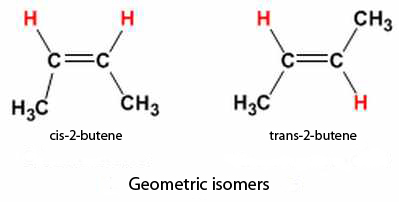
Geometric isomers: they are differentiated by how the atoms are configured around double carbon bonds C=C. Thus, we would talk about cis configuration, when we find the same groups of atoms at the same side of the double bond, and trans configuration, when they are arranged on opposite sides. Trans configuration generates an approximate linear molecular structure, whereas the cis configuration originates a bend (change in direction) of the backbone.
Cis and trans configuration of isobutene

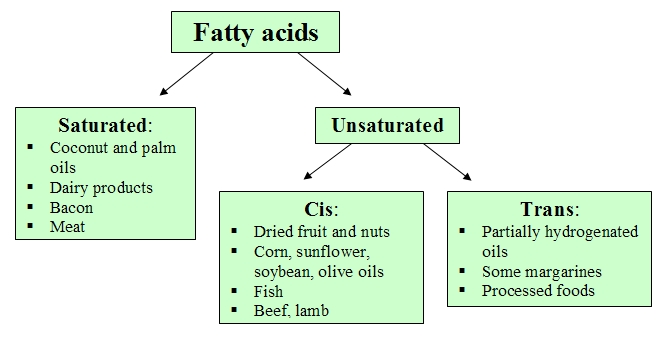
Triglycerides[2] (fats and oils) are classified according to the fatty acids[3] they contain. Thus, those fatty acids with at least one double bond between carbon atoms are unsaturated fats. When some of these bonds appears with cis configuration, the triglycerides molecules cannot be grouped or packed, so they are liquid at room temperature constituting those substances known as oils.
However, if the double bond  presents trans configuration, the molecules are able to pack tightly at room temperature forming solid fats, popularly known as trans fats, such as partially hydrogenated oils, processed foods and some margarines. In the human diet, these fats are associated with an increase in cardiovascular diseases, therefore they have been significantly reduced and/or eliminated in lots of food products in food sector.
In contrast, those triglycerides that lack double bonds between carbon atoms are named saturated fats, meaning that they contain all the hydrogen atoms available. These fats usually solidify at room temperature and are found in food of animal origin, milk and its derivates, and even in some oils of plant origin, such as coconut and palm oils.
Classification of fatty acids

Enantiomers

Enantiomers are molecules with the same bonds and identical chemical structure but with different arrangement of their atoms, such that they are mirror images of each other. An example is some D and L- forms of amino acids which have very different functions, the D-form of amino acids composes the cell walls in some bacteria, and the L-form of amino acid makes proteins.
L- and D- amino 
acids


Functional groups

Functional groups are groups of atoms in molecules, which give them some specific chemical properties. In this way, each one of the four groups of biological macromolecules (carbohydrates, lipids, proteins and nucleic acids) has its own set of functional groups which provide them chemical properties and very particular functions in living organisms.
These groups are attached to the carbon backbone at several points in macromolecules along their linear chain and/or ring structure.
Functional groups are usually classified on the basis of their charge or polarity, in hydrophobic (uncharged molecules that do not interact well with polar molecules like water) and hydrophilic (polar ions or molecules that do interact well with other polar molecules).


[1] Those molecules that contain any form of carbon (solid, liquid or gas) which are vital for life.
[2] Compound made of a glycerol molecule as a backbone with three fatty acids attached.
[3] Long aliphatic chains usually containing an even number of carbon atoms (16 - 22). Their structure is mainly hydrophobic (repels water) with a carboxylic group as a functional group with acidic character.

Sources: OpenStax College, Biology. OpenStax College. 30 May 2013.              
              http://perdergrasa.bligoo.es/clasificacion-de-trigliceridos
              http://recursos.cnice.mec.es/biosfera/alumno/2bachillerato/biomol/contenidos9.htm
              http://biomodel.uah.es/model2/lip/acgr-salud.htm


Read more